Travel

Under Fire … in Afghanistan, some time ago

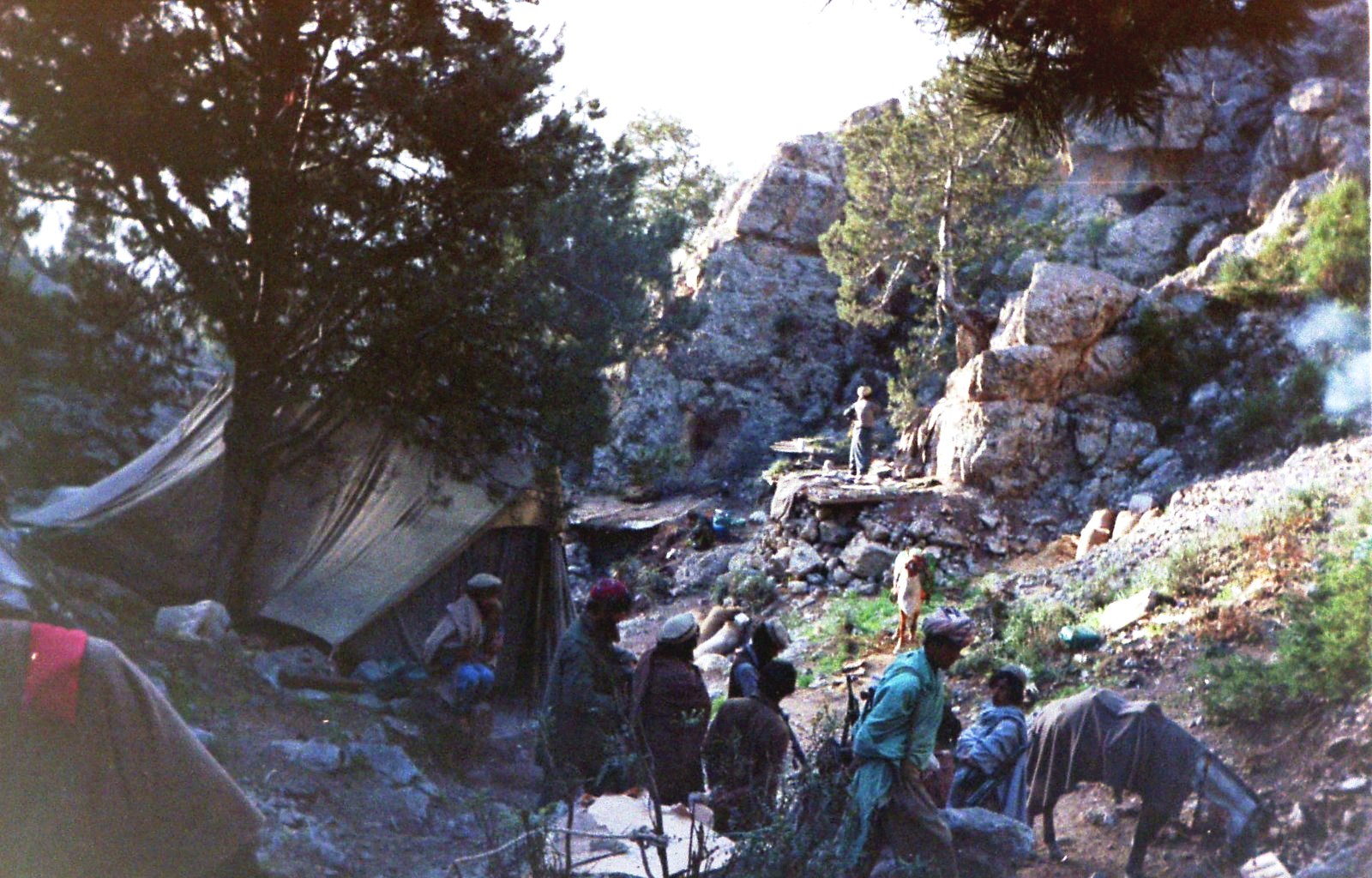
The morning after… this is the tent at Badullah where we were under mortar bombardment; my baptism of fire, sort of…

Reading about the terrible battle in Vietnam’s Ia Drang Valley in Hal Moore’s book “We Were Soldiers Once… And Young” reminds me of my own comparatively puny experiences of coming under fire in Afghanistan 20-odd years ago. It also reminds me of the horribly realistic first half hour in the movie “Saving Private Ryan.” I wonder if having bullets whizzing around your ears is more scary than artillery shells exploding nearby – which is what I experienced. I never faced small arms fire, although a volley of machine gun bullets dug up the ground in front of my feet during the civil war in Lebanon once in June 1985 — a warning from the Lebanese Forces against my taking pictures.
In Afghanistan, on my first trip after the Soviets invaded, I was with Abdul Rasul Sayyaf in Jaji, Paktia Province in late August 1984, two months after the same Sayyaf welcomed Osama Bin Laden in the same area on his first visit to that country. Bin Laden and his men had their baptism of fire under Soviet aerial bombardment in Jaji that time (according to the excellent book “The Looming Tower” by Lawrence Wright) — they were scared shitless, and Sayyaf and his seasoned Afghan fighters thought those guys were useless. Three years later Bin Laden would become the big Muslim war hero after a battle with Soviet commando forces in the same area.
I had my own baptism of fire – so to speak – also together with Sayyaf’s men, in a forward base they called Badullah, in a small tent pitched behind a rock at the foot of a range of hills overlooking the high plain near the army garrison Sayyaf’s men just named “Chownee,” which apparently just means cantonment (perhaps Ali Khel, I don’t know for sure – a larger army base a little further out was called Narai). Mujahideen were firing 82-mm mortars from positions just above us into Chownee, and an artillery gun, mortar crews and at least one tank fired back towards us from the garrison. Mortar bombs and artillery shells were exploding close by as I was talking — actually shouting — to Commander Mohammed Naim in that little tent. The mujahideen seemed unperturbed by the din and the shaking of the ground under us. They knew we were safe. I was a bit queasy but their confidence made me feel better. At one point a mujahed stepped out of the tent for a second after a mortar bomb explosion very close by and came right back, dropping a very hot piece of shrapnel in front of me. I picked it up later and kept it as a souvenir.
Another time, in a camouflaged Dashaka .50 caliber (12.7-mm) heavy machine-gun position a bit closer to Chownee I was with mujahideen who were firing into the army base, trying to hit a building where 7 Soviet advisers were staying, according to Commander Naim (based on info from defectors). I was supposed to fire that gun myself at one  point but it jammed. A tank from the base fired a few rounds back at us. The first two fell short but the third one passed just above our heads – so close you could “feel” it  – and blew up a tree some 50 meters to the rear.
A year later in August 1985 I climbed over high mountains along the Afghan-Pakistani border with a different group of mujahideen (Yunus Khalis) who were planning to attack the exposed Afghan army garrison of Barikot in the Kunar Valley. They fired a total of 17 rockets from a place on the river the fighters called Narei. The response took longer than I expected, indicating to me that the rockets had probably missed their target. The first mortar round from Barikot exploded in the exact location from where the rockets had been fired. You can hear them whistling if they are going to hit some distance away — not if they come too close. Of course, there was no one left in that place. The next round came quite a bit closer to where I was — still whistling. They were taking potshots, but they might get lucky and hit us. Another round changed direction a little bit, again, and I thought my cover behind a mud wall might not be good enough. The fourth and last round took out a chunk of the corner of a mud house about 50-60 meters from me.
In October 1987 I was in the Kunar Valley again, much further south and perhaps about 8 km or so north of the capital Asadabad and the nearby Soviet air base of Chagha Sarai. I was with Commander Ajab Khan on top of Tari Sar hill, watching as mortar bombs fired by mujahideen in the mountains to the east exploded closer and closer to a small army base called Shigal Tarna just across the fast-flowing river below. The commander used a walkie talkie to direct the crews. Finally one, two, three bombs exploded right in the middle of the base. “Allahu Akbar,” resounded the cry of the mujahideen. During the whole time a heavy artillery gun inside the base had kept up a slow but steady fire into the mountains and its boom reverberated through the valleys. But now, suddenly, we “felt” something like a swishing sound in the air above us, and seconds later a hillside to the northeast was covered by plumes of smoke. “Bimsiezda,” commented one mujahed. It was a Soviet multpile rocket launcher, firing from the Asadabad area. Shortly after the second rocket salvo whizzed by we were on our way down the hill to get back to the Mujahideen caves and dugouts in the Shultan Valley closer to the Pakistani border. Just before we left the position we saw a helicopter landing in Shigal Tarna, possibly coming to pick up wounded soldiers there. There was no more fire from the mujahideen mortar crews after this but soon the “dooshman” or “shuravi” (enemy) were firing into “our” Shultan Valley from three sides with rocket launchers, field guns and heavy mortars: Asadabad to the south, Shigal Tarna to the west and the Asmar garrison upstream to the north. I don’t know if this can be called a barrage but the shelling continued for a long time until late into the night. The ground shook many times under our feet and the sound was frightening once or twice when several very heavy shells exploded close to each other not much more than 100 meters away and lit up the valley. But it seems they did not use airburst munitions because I think some of us would have been blown away. Also surprisingly, there was no air activity, and in fact I never once experienced being under aerial bombardment.
The big difference between my experiences and those of most soldiers/fighters in combat or civilians under bombardment is that neither I nor any of the mujahideen close to me was ever wounded or killed. I saw one wounded mujahed being carried by others in the mountains once, and another who had bled to death after triggering a land mine that blew off his legs — but his body had already been wrapped up in blankets. I didn’t see anyone getting hurt in battle. I think if I had I might have been just as scared as Bin Laden’s men in their first experience in Jaji. So, yes, I have been under fire — but it was nothing at all compared to what unfortunately too many other people have experienced. And it continues…
Like most if not all of those people I wish for peace.
Erwin Franzen
Some of my pictures from Afghanistan: https://www.flickr.com/photos/erwinlux/sets/

Rockets ready to hit Barikot garrison -Kunar Afghanistan August 1985

***************

 ***************
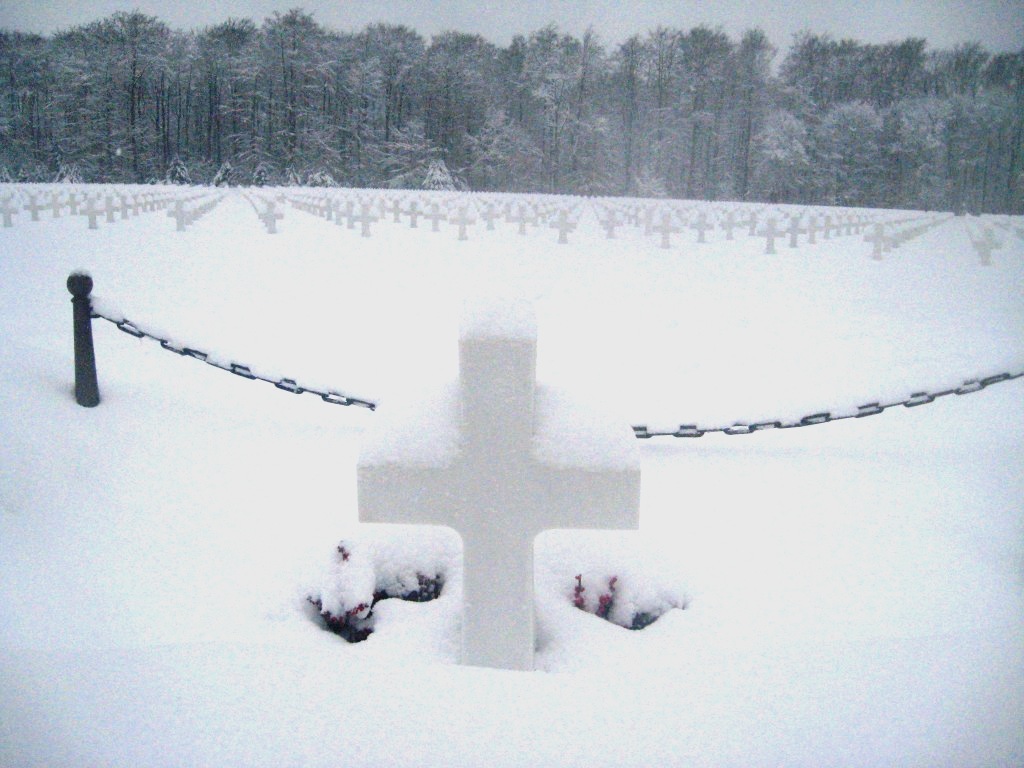
General Patton's grave deeply buried in snow -Luxembourg Dec 2010

General Patton’s grave deeply buried in snow -Luxembourg Dec 2010

My message about peace in answer to a question from a family member of General George S. Patton, Jr., the World War II US Third Army commander who rests among over 5,000 of his troops in my workplace, the Luxembourg American Cemetery: 

……
I think the most worthy goal is to work for peace, which means first of all to help people to believe in peace — world peace, that is.
Humankind has lived with war throughout the history we know, and because of that most people nowadays don’t seem to believe world peace is possible — unless a heavenly Savior comes down to earth and uses supernatural powers to establish it (by force?). Too many people think it’s naive to believe that hunmankind can build a peaceful world, and any effort in this direction is doomed.
 —-
Your grandfather fought in the two world wars and he could surely see how the outcome of the first one led almost directly to the second one, and he also foresaw that the second one could lead to a third one. He needed war in a way – to prove himself as a soldier – but he also needed peace for his family. He did not get a chance to see the peace that has now lasted 60 years over all his battlefields in western Europe. His son, your father, followed in his footsteps in war but he also saw the peace, and he consolidated the gains made by your grandfather in southern Germany after the war by building a friendship with former enemies.
 —-
Your generation of the Pattons has really grasped the value and meaning of peace, and I think there is something big there on which you can build real faith in peace — and inspire others to believe.We cherish freedom, and the saying goes that it is not free. But does war give us freedom? Does war make us secure — even if it is a war our soldiers fight in distant places? Are those places really so distant anymore in this day and age? Can we always rely on the west’s overwhelming military superiority to ensure our freedom and safety and prosperity by taking war to other lands and keeping it away from our shores? Is that good, right, just?
 —-
Can we label other people as “evil” or as “barbarians” or “rats” (or “terrorists” or “enemy combatants”) and then utterly destroy them, and go on to live in peace with ourselves? Hitler and his gang tried that with the Jews, for example… Luckily they were stopped and defeated before it was too late. However, ideas similar to theirs continue to proliferate in different guises and in insidious ways. We have to guard against that by promoting peace.¨Not long ago our agency, ABMC, adopted a “new” motto: Time Will Not Dim the Glory of Their Deeds — which is something Gen. Pershing said after WWI. I think WWII came to dim somewhat the “glory” of those deeds — because it showed that regardless of their own value the larger cause for which they were done (the war to end all wars) was lost. And other wars since then have dimmed the “glory” of the deeds done in WWII. But is “glory” the true message of our cemetery?
 —-
Does glorification help to promote peace, freedom – all the things we cherish most?Many American visitors to our cemetery also like to visit the German cemetery, and some of them find it drab and uninspiring compared to the beauty of ours. It is the final resting place of those who fought on the side that lost the war. But the idea behind the German cemetery is to promote peace. In all the literature of the German war graves commission (Kriegsgräberfürsorge) I find one theme that is emphasized: peace.
 —-
I wish our cemetery could also help to inspire people to believe in peace.
Luxembourg American Cemetery -summer 2007

Luxembourg American Cemetery -summer 2007

***************

 ***************

My view of the 2003 US attack on Iraq

 —-
Adapted from an email to a friend in April 2003 – a month after the USA attacked Iraq:
 —-
… I have several major problems with what I see in the beliefs and attitudes of many conservative and neoconservative Americans today. For one thing: they seem to value the lives of “Americans” (actually, most especially Americans of European or primarily European ancestry, meaning “whites”) so highly that the taking of one of them can only be avenged by the deaths of tens or even hundreds of “others.”
 —-
I have met Americans and read opinions of others who seem to feel, for example, that even the firebombing of Tokyo and the incineration of Hiroshima and Nagasaki were not sufficient revenge for the attack on Pearl Harbor (that and the Bataan Death March [here the few hundred American dead counted far more than the many thousands of Filipinos who died at the same time] seem to figure much more prominently in Americans’ minds than the Rape of Nanking and other Japanese atrocities in China and Korea, and elsewhere).
 —-
To many Americans, it seems, the deaths of over 55 million “others” in World War II don’t really compare in significance to those of the 400,000-odd American servicemen/women who also died at that time. Perhaps, if they could be brought to seriously think about it, their feelings would be different. I don’t know.
—-
I am also worried that the Christian conservatives seem to be turning their America into something akin to a religion. I feel that there are grave dangers in exaggerated nationalism, especially when it is combined with a certain callous and arrogant attitude towards other nations and the will to use an awesome military machine that can kill thousands of people (even if they are labeled “terrorists” or simply called “ragheads”) in the blink of an eye without risking any serious retaliation.
—-
You know, there have always been “really evil” people. Can you say that the thousands of Taliban or even Al Qaeda members and camp followers who were wiped out in Afghanistan or the thousands of Iraqi soldiers blown up in the latest conflict — quite apart from the civilian lives lost or destroyed — were all really evil? Of course not. So how are they to be accounted for — as expendable for the sake of the greater good? What greater good…? Who decides and based on what? This is might, not right!
—-
Saddam Hussein and his gang can surely be called evil — but he didn’t just suddenly come to power in Iraq — nor is he the only evil one around. But one thing is for sure: whatever military capabilities he ever possessed, they were absolutely nothing compared to the power that just swept him away. The United States has by far the most potent nuclear, chemical and biological warfare capabilities in the world.
 —-
Luckily for us (so far), it has a fairly good system of checks and balances that normally restrains it from any misuse of those capabilities on a massive scale. I believe everyone needs to do their best to help that system of checks and balances work as it should — and that may sometimes mean opposing the government in power or warning of the dangers one sees in certain courses of action.
 ***  Today, 4 years later, I have the impression that the system of checks and balances has broken down. This is much more dangerous than any threat from “terrorism.”
***************

***************

On how my political views changed twice, and how I spent 3 days in prison — in Czechoslovakia

From an email to a friend at the University of Illinois:
 —-
… Before I came to the US and met the church (= ‘Rev.’ Sun Myung Moon’s Unification Church, which I joined in New York in March 1975) I had been politically left-leaning, strongly anti-Vietnam War, and I actually believed the US would start the nuclear war I expected. The church in the US turned me into a pro-American anti-communist.
 —-
After joining The News World (a NYC daily founded by Unification Church members) I started reading other newspapers such as The New York Times, which we thought were dominated by liberals and leftists. What I read in those papers challenged both my intellect and my acquired sense of morality because it made me feel increasingly uncomfortable with the church and our paper’s position against what was derisively called “secular humanism.” Jimmy Carter and his people were always talking about human rights but our church did not seem to agree with this, and we embraced Latin American fascist dictators just because they were anti-communist.
 —-
I felt increasingly alienated by a lot of other things as well, but looking back now I find it amazing that I stayed in the church and continued to believe in the Divine Principle and Moon (Sun Myung) for so long. It’s good to see that it took you and many others like you much less time to decide to leave.
—-
Most of my time on The News World I was an assistant editor in the international news department, mostly combining and rewriting wire dispatches and reports from our own foreign correspondents (almost all of them church missionaries). I also wrote a number of articles under the pseudonym Aaron Stevenson, which Carol L. of the Opinion/Commentary department had chosen because my first published pieces were commentaries. Our first publisher was actually Dennis O.. Mike W. came a little later. If you worked in circulation you must have known Joachim B. and Nick B..
 —-
The only time I used my real name in the paper was when I worked in Washington D.C. with Josette S. in 1979. In New York we were worried about the INS people coming to check whether we employed illegal aliens — and of course I myself was one and there were quite a few others — but there was no such concern in D.C. I received many reports from the Pentagon over the years including all the SecDef annual reports to Congress from Donald Rumsfeld’s last one under Ford to those by Carter’s SecDef Harold Brown and the first ones by Reagan’s man Caspar Weinberger.  They sent them to me in New York for free.
 —-
In Czechoslovakia in March 1982 five soldiers took me off the Vienna-Berlin train at Tabor, south of Prague, where I was thoroughly searched (stripped naked) and then kept under guard (two soldiers with Kalashnikovs right behind my back even when I went to the toilet) for several hours until two men from the Interior Ministry in Prague arrived. Some of the things they found in my luggage had made them suspicious, including some of our anti-Soviet material and one or two of those Pentagon annual reports (a diary they found also contained contact info for a man I had called a few times from New York for information: former Navy Captain Herbert Hetu, who opened the CIA’s first Public Affairs office under then-director Stansfield Turner — I found him again not long ago, here: http://www.arlingtoncemetery.net/hehetu.htm ).
 —-
I was taken at night to a big office building in Ceske Budejovice (Budweis in German) that turned out to be a high-security prison and interrogated (without any violence) for hours throughout the next day. On the third day they decided to send me back to Austria, took me to the border at Ceske Velenice and put me on a special train (I was the only passenger on that train), with two soldiers with Kalashnikovs watching as the train headed into the forest towards Gmünd on the Austrian side (I guess they thought I might jump off before the train crossed the border).
 —-
.. And yes, you are right about the Unification Church mindset. Some of my old colleagues on the UC newspapers are still out there fighting the big enemy we fought in the 1970s, only now it is called “terrorism” instead of communism.
***************

Categories: Travel | Leave a comment

My last trip into Soviet-occupied Afghanistan, in 1987

Kunar Ajab Khan

Commander Ajab Khan test-fires a 14.5-mm Zikuyak in Shultan Valley, Kunar – Oct. 1987

It’s been over 20 years since I wrote this story. The writing is a bit awkward because I was under strict orders from my editor to avoid penning it as an account of a personal experience, which of course it was. — It was my 4th and last visit to Afghanistan since 1972, the 3rd one since the Soviets invaded that country at the end of 1979. — I have inserted some text in italics and square brackets for explanation.

One of the people mentioned, the one-eyed Italian would-be mercenary Eugenio, was an interesting character whom I met in a dingy, cheap “hippie” hotel in a dark corner of Peshawar. He had a glass eye, which he took out to clean from time to time. He said he’d lost his eye to a stray bullet somewhere in Europe. He had spent 2 months in Logar, Afghanistan the previous year with mujaheddin attacking convoys on the main road from the south to Kabul, and, like the French guy Jacques, he wanted to get into some more action this time.

I was shocked when Eugenio showed me a picture of two beautiful baby boys and told me those were his sons back in Rome. He gave me the address of his girlfriend, their mother, in Rome and told me to contact her in case he didn’t make it out alive….

asadab.DO [For information: This was originally written on a small NEC PC-8201 laptop with less than 32 kilobytes of usable RAM. This is scanned from a printout of the original, unedited version that I typed up in Peshawar]

ASADABAD — KUNAR PROVINCE (18-22 October 1987 — written on 1 November) [1987 in Peshawar, Pakistan]
[from my article in the Middle East Times weekly, based in Cyprus — now long defunct]

TARI SAR PLATEAU, Afghanistan — Mujaheddin commander Ajab Khan, a short, wiry man with a vaguely bird-like quality in his movements and speech, is perched precariously on a rocky outcrop. In rapid Pakhtu, he is speaking into the microphone of a red plastic walkie-talkie. Next to him, Pazlimalek, a tall, seasoned fighter at 25 with a thick beard, leans on a flat rock and peers through binoculars into the Kunar Valley far below. 

Seconds earlier, the heavy blast of the driving charge of an 82-millimetre mortar reverberated through the rugged mountains and valleys to the east of the fast-flowing, slate-grey Kunar River. Then a small cloud rose from some low hills across the river, just above Shigal Tarna, a garrison of a few hundred government troops. 

“Down five millièmes,” suggests Pazlimalek, and the commander repeats the message into his microphone. The next mortar bomb, fired by one of two mujaheddin positions in the mountains near the border with Pakistan, explodes on the road that leads to the base of the Soviet-backed dushman, the enemy. The second mortar also places a bomb close to the road. 

“Allahu Akbar — God is great,” shouts the commander. Pazlimalek suggests a further slight shift in the aim of the mortars. Soon, the cries of “Allahu Akbar” multiply as, one after another, three clouds of smoke from mujaheddin mortar bombs rise in the middle of Shigal Tarna itself.

Later, the mujaheddin fire a few 107-millimetre rockets from a single, man-portable tube — the Bimyak — and, following some adjustments in the aim of the weapon, rejoice when two of the missiles hit a large house in a village by the Shigal River upstream from the army base. People in the village, the families of pro-government militiamen from other regions who were resettled there to occupy houses left behind by refugees, can be seen running for cover. 

Throughout the firing by the mujaheddin, the heavy thump of a large-calibre artillery gun can be heard from the government base, followed by the explosions of its shells in the mountains to the east. The gun, well hidden under earthworks in Shigal Tarna, fires roughly one shell a minute.

On a different frequency than that used by the mujaheddin, the radio crackles with the excited voice of the commander of Shigal Tarna base. Later, another voice speaks in rapid Russian.

Suddenly, the air above Tari Sar Plateau is filled with a sort of swishing sound that is followed within seconds by a series of powerful explosions. Flashes can be seen on a mountainside across the lower Shultan Valley, and soon clouds of smoke cast shadows over the pine-covered slopes.

“Asadabad, Bimsiezda,” Pazlimalek tells three foreigners who watch the spectacle from the vantage position on Tari Sar. Bimsiezda is the Afghans’ term for one of several modern versions of the famous Stalin Organ multiple rocket launcher that was dreaded by invading German soldiers on the Soviet front in World War II. Asadabad is the capital of Kunar Province and the site of Chagha Sarai military base, roughly 10 kilometres to the south of Tari Sar Plateau and about twice that distance from the Pakistani border.

[I had brought two other Europeans with me to this place in Afghanistan: Eugenio, a one-eyed Italian adventurer and Jacques, a French ex-Foreign Legionnaire. I ran into them separately in Peshawar after each of them had tried in vain for weeks to find a mujaheddin group that would take them across the border. I then took them to my contact Engineer Es Haq in University Town, who arranged the trip for us after they presented themselves as journalists like me – which they were not.]

High above Asadabad, on two mountain plateaux to the east and one to the west of the Kunar River, Soviet Spetsnaz commandos have established small permanent bases that are regularly supplied from the valley by helicopters, mostly at night. Four helicopters were parked on the tarmac of an airfield at Asadabad when the fighting around Shigal Tarna began.

Pazlimalek claimed that each of the three mountain bases, Soder Sar, Mechellay Sar and Shahbazay Sar, housed about 300 Soviet commandos. According to Ajab Khan, the Spetsnaz have a Bimsiezda on Soder Sar, only a few kilometres to the south of Tari Sar mountain and clearly visible from the highest peak above this plateau. [I believe I must have misunderstood this at the time; the Bimsiezda must have been in the valley, not on the mountaintop. Also, surely, the number of Spetsnaz forces in those locations could not have been as high as the mujaheddin claimed] 

The mujaheddin count 13 rockets in the first salvo. A second salvo blasts the same mountainside across the valley with nine rockets but all fail to hit the mujaheddin mortar and Bimyak positions.

Commander Ajab Khan was well aware that the Soviets, together with the Afghan government forces, could lay a heavy rocket and artillery barrage over the entire area under his men’s control, including Tari Sar mountain. They could also call in Mi-24 helicopter gunships and Sukhoi-25 ground attack jets to blast the mountains and valleys all around, as they did just two months earlier in August. Compared with the firepower at the disposal of the communist enemy, that of the mujaheddin seemed truly pitiful.

Normally, the mujaheddin would continue to fight no matter how much retaliation they had to expect from the Soviets. But this time, the commander felt responsible for the lives of the three foreigners, the first to visit this area since Ajab Khan and his men established their bases on the massive rocky ridges along the upper Shultan Valley about two years ago. He decided to call off the attack on Shigal Tarna at about 1:30 p.m. and save his remaining mortar and rocket ammunition for future operations.

** 

[Actually, in retrospect, I don’t think Ajab Khan broke off the attack because he was concerned about us 3 Europeans. I found out a bigger attack was to take place a few days later with a larger force. A week or two after these events I met the well-known American correspondent Kurt Lohbeck (since deceased) at the American Club in Peshawar, and when he heard I had been north of Asadabad he told me he went there a few days later and filmed a major offensive by the mujaheddin towards the Kunar capital in which they came close to capturing the town.

I could not believe it and asked if I could see his film, but he said he had already sent it to New York for editing. It then occurred to me that most likely the mujaheddin had sent me and my companions out of the area because they wanted to give Lohbeck exclusive coverage of whatever operation they planned — Lohbeck himself may have asked for it — because he was a much more important witness than we were.

I have never since been able to find any information about the battle for Asadabad that Lohbeck said he filmed, and the town was captured only a year later — months after Soviet forces withdrew from the area. — 

Also, our mujahed guide Mohammed Kaftan was unhappy when he realized Eugenio and Jacques were not journalists as they had claimed, because they did not have cameras, never took notes and were only interested in getting Kalashnikov assault rifles from the mujaheddin so they could join them in fighting.

They did get the Kalashnikovs but were very disappointed they couldn’t use them when we were under artillery bombardment far from any enemy soldier. Kaftan is the one who insisted on sending us back over the mountains to Pakistan].

**
While some mujaheddin based on a mountain to the north fired random shots from a heavy single-barrel 14.5-millimetre anti-aircraft gun as a diversionary tactic, the commander had a few of his men lead the three foreigners down into the Chowgam Valley below Tari Sar Plateau.

From there, the party proceeded over several ridges back to the mujaheddin camps in the upper Shultan Valley. But although the mujaheddin stopped firing early in the afternoon, the riposte from the Soviets and the Afghan army continued for several hours until long after sunset.

A slow but steady rhythm of heavy mortar, artillery and rocket fire continued to rock the Shultan Valley, coming from the nearest Soviet commando base on Soder Sar Plateau to the south-west, Shigal Tarna to the west and Asmar to the north-west. Two of the Bimsiezda rockets tore holes into the mountainside only about 10 metres above one of the mujaheddin’s Zikuyak 14.5-millimetre machine-gun positions.

The operation cost the life of one mujahed, who stepped on a mine near the east bank of the Kunar River and apparently bled to death after losing both legs. His body was later carried on a mule for burial in the Bajaur tribal area of Pakistan.

The number of casualties on the other side of the river was not known but mujaheddin reported that one helicopter made at least two return trips between Asadabad and Shigal Tarna, presumably carrying wounded people to a hospital in the city.

The mujahed who became shaheed, martyred, had triggered the fighting somewhat earlier than planned when the mine exploded under his feet. Firing had started along the Kunar River before the mujaheddin mortars and the Bimyak, carried by mules on treacherous paths up the mountains, were in position.

Soldiers in Shigal Tarna raked the east bank of the Kunar with bursts of heavy machine-gun fire and one tank blasted the lower slopes of Tari Sar, while mujaheddin near the river responded by firing rocket-propelled grenades and rifle bullets.

In the Kunar Valley, there is a striking contrast between the military situation to the north of Asmar and that to the south between Asmar and Asadabad.

In the north [north of Asmar, where I went with another group of Yunus Khalis mujaheddin two years earlier, in August 1985], the mujaheddin control a number of villages along the river itself and have laid siege to the government garrison of Barikot near the border with Pakistan.

In a major offensive during the spring of 1985, a division-sized Soviet force [in hindsight I’m sure I was misinformed about this — there is no way the force could have been that large] backed by an estimated 100 warplanes and helicopters fought its way up the narrow dirt road along the Kunar to relieve the besieged garrison at Barikot, using airborne Spetsnaz commandos to destroy as many as nine anti-aircraft machine-gun posts that the mujaheddin had set up on mountain peaks overlooking the valley.

The Soviets managed to bring Afghan army reinforcements to Barikot but as soon as the main Russian force returned to the south the mujaheddin retook control of almost the entire stretch of road between Asmar and Barikot, established fresh machine-gun nests in the mountains and resumed their siege of the border garrison. 

In May last year, Soviet jets destroyed an important bridge across the Kunar River between the villages of Sao and Neyshagam north of Asmar in an effort to deny the mujaheddin an easy way to cross to the west bank with their mules laden with heavy arms. According to Pazlimalek, the mujaheddin have since stretched at least three cables across the river and use rafts to transport heavy weapons and ammunition, and they are trying to repair the Sao bridge as well as another one at Narei further north. 

South of Asmar, however, the Soviets have made a strong commitment to keeping the Kunar Valley under direct control and it is extremely dangerous for the mujaheddin to try to cross the river. The east bank of the river is heavily mined, and the Soviet commandos in their mountain bases above Asadabad are ready to intervene at any time should the mujaheddin threaten any part of the valley.

Due to the possibility of surprise attacks on mujaheddin strongholds by helicopter-borne Spetsnaz forces, the guerrillas keep guard posts with watchdogs on all the strategic high points above the Shultan Valley as well as in some of the villages in other side valleys of the Kunar.
The majority of the original inhabitants of most farming villages on both sides of the Kunar Valley have fled to Pakistan since Soviet forces pushed into this extremely rugged region more than four years ago, using heavy bombardment to terrorize the population.

Many of the men from those villages are now mujaheddin. After the Soviets asserted control of the valley, tribesmen who were willing to work with the government that was installed during the invasion in December 1979 were resettled in some villages, occupying abandoned houses and farmlands.

Few civilians live in the villages of the lower Shultan and Chowgam valleys just to the east of the Kunar, in the areas under mujaheddin control. Some families whose houses are still intact remain in the area despite frequent fighting nearby, growing maize and wheat, tending orchards and raising cattle, sheep and goats.

Some children were playing in a field at Gaweja village as mortar bombs, rockets and tank shells passed high overhead, exploding in the mountains to the east. The children belonged to the only family that remained behind in the village, and they seemed almost oblivious to the din. All other families had long fled.

Just across the valley, the village of Wan was completely abandoned. Scattered bomb craters and gaping holes in most of the houses, which were built of rocks and mud, provided mute testimony to the tragedies that must have forced the people out.

Considering the Soviets’ enormous advantage in firepower and equipment, and the very rough conditions under which the mujaheddin continue to live and fight their jihad (holy war) in this region eight years after their country was invaded, it comes as a surprise to witness the courage and determination of these fighters.

The most active group of mujaheddin in the Kunar Valley, both north and south of Asmar, appears to be the Hezb-e Islami (party) of Maulvi Yunus Khalis, an aging but tough leader who was recently named chairman of the seven-party Ittihad-e Islami Mujaheddin Afghanistan (Islamic Alliance of Afghan Mujaheddin) based in Peshawar. Maulvi Khalis is expected to lead a mujaheddin delegation which will attend the debate on Afghanistan in the United Nations General Assembly beginning on 9 November.

The three foreigners who visited the Shultan Valley for five days to watch the attack on Shigal Tarna in late October were impressed by the fervour with which the mujaheddin practised their faith. Islam is a very demanding religion. To pray five times a day in the Islamic way is not easy, especially under difficult conditions such as those encountered in the jihad in this rugged land.

At one point, on the day before the attack on Shigal Tarna, a small group of mujaheddin raced at breakneck speed over very treacherous terrain for well over an hour just in order to reach a mosque in an abandoned village in time for the maghreb (sunset) prayer.

After eight years of a terrible war against a superpower in Afghanistan, it is perhaps no wonder that only a fervent commitment to their religion, Islam, can provide the mujaheddin with the courage and determination to carry on their difficult struggle. 

END OF ARTICLE 

Categories: Travel | Leave a comment

Memory of California Thanksgiving 1975

Postcard from Lathrop / CA to my parents the day before Thanksgiving – in German

Excerpt from my diary entry for Thanksgiving Day 28 November 1996: 

… Today being Thanksgiving reminds me of my most memorable Thanksgiving Day in America 21 years ago (it was also my first Thanksgiving there since I arrived in the States on 6 March 1975). That year, 1975, Thanksgiving Day fell on 27 November, a day earlier than this year.
The day began, for me, in a boxcar of a freight train about 10 kilometers or so east of a town called Tracy, which is somewhere to the southwest of Stockton, California. It had been my third and last ride on a freight train in California (the first ride had taken me from Roseville outside Sacramento, where I had spent 3 days without a roof over my head, to a railroad yard only a couple of miles away, and the second ride was from that yard to Stockton at night).
With me in the boxcar outside Tracy was a man whom I had met in Sacramento (at the Salvation Army soup kitchen) a few days earlier and who had given his name as “Bob Robinson,” from West Virginia (if I remember correctly). We had tramped together. He had been on many freight trains and could tell many horror stories about life as a hobo. He said he also once spent 8 years in jail in Louisiana on charges of armed robbery. And he said he had fought in Korea. I estimated his age at 40-45. And he also said he’d been a boxer.
We had gone from Stockton to a place called French Camp, hitch-hiking and walking, planted onions in a field together with some Mexican workers for a few bucks. Then we went on to the small town of Lathrop and spent the next two cold nights out under the stars on a nearby swath of tumbleweed-strewn wasteland. I bought bottles of cheap red wine here and there along the way, and he drank most of it (he wanted the stuff but said he had no money, so since we were traveling together I bought it for him).
We hoped to be able to catch a freight train going south through Lathrop, but the ones that passed were all going too fast. No way to catch them. “Bob” (he also called me Bob because he could not memorize my first name) had persuaded me to come with him to Indio, southeast of Los Angeles, for the winter, where he had previously worked in lumbering and where he thought we might both find temporary work.
The third night at Lathrop, on the eve of Thanksgiving, we saw some workers preparing a freight train for a trip. There were two nice boxcars, one with both doors wide open — just right. Bob got in while I went to get my backpack and his bedroll. When I came back there was no sign of Bob. It was pitchdark inside that boxcar. When I called him there was a muffled sound as if someone moaned in pain.
I got in and the moaning intensified. There was something big on the floor under my feet and when I touched it I realized that there were several big and heavy wooden boards lying there. It turned out that they had been standing upright when Bob arrived, leaning against the wall of the boxcar and fastened there. Bob had apparently loosened them and they fell right on top of him. I pulled them off to the side one after another. They were so heavy that I could only lift one side of one of them at a time.
I couldn’t see Bob’s face but he must have been miserable. He complained of excruciating pain in one leg and one side of his pelvis/hip. And he stank of excrement. His pants were full of shit. I assumed that the heavy load must have pressed on his abdomen, forcing his feces out. Luckily I had a spare pair of pants in my backpack. So I used handkerchiefs and paper tissue and a small towel to clean up his legs and buttocks in the dark after carefully pulling off his soiled trousers (he couldn’t move one of his legs at all and couldn’t even turn on his hips).
He cried in pain. Very slowly I inserted his legs into my spare pants and then covered him with his blankets. He asked me to take him to a doctor. I would have had to carry him, of course. The workers outside were long gone (we had waited till they left before approaching the train). There was an engine at the far end of the train but I didn’t know whether it was manned at this point. I was a bit hesitant to take him to the town because I was an illegal alien in America, liable to face a brief jail sentence and deportation if caught, and we had already committed an offense by just getting on the freight train in the first place.
Moreover, I was upset with Bob at the time because he had broken into a trailer home that day trying to steal something. That trailer belonged to a nice middle-aged couple from Missouri (which they pronounced something like “Mazarra”) who had invited us in that morning for a cup of coffee when they found us creeping out of our hoarfrost-covered beddings amid the tumbleweeds. They had told us they planned to drive to Stockton that day, and they left the trailer sitting there. It was not very big but it contained, among other things, several bird cages with various small birds in them, and 2 or 3 dogs.
I gave Bob his wine that evening. He usually took only a few gulps but I later found out he had emptied the bottle this time while I had gone for a walk. I returned to our camp when I heard the Missourians’ dogs barking. Bob came back from the trailer. He was drunk. He confessed that he’d smashed a window with his fist, trying to break in, but gave up when the dogs went crazy. I told him we couldn’t stay together after this. I would not go with him to Indio — and anyway, we had to get out of this area fast because the Missourians would call the police when they returned.
Not long after that … [continued on 30 November 1996, Saturday:] … we saw the fateful train with the open boxcar and decided to take one last ride together.The train started moving before I could make up my mind to take Bob to a doctor. We didn’t go very far, though. Probably less than half an hour. The train stopped in what appeared to be an uninhabited area, because there were no lights except a small one outside a low building nearby that seemed to be empty. At the far end of the train I could see the engine leaving. We were alone in the dark.
In the morning I saw that we were on one of several railroad tracks, and that a road ran beside them — although there was a low fence in between. Bob was still in bad shape. I picked him up carefully and carried him to the fence by the road. Somehow I managed to get him over the fence. He moaned a lot and appeared on the verge of passing out at one point. He clearly was in great pain when I moved him. I brought our luggage.
We found out that Bob was able to stand on one leg, and so we stood there, Bob leaning against me, waving wildly at the first car that came up on the road. It sped off. After a while a second car came, and its driver was less afraid than the first one. He rolled down his window and I told him we needed an ambulance as my companion had broken his leg in a bad fall. 
The man drove off, and sure enough, not much later he came back with an ambulance. Bob was put on a stretcher and I rode in the front of the ambulance with the driver. He told me that they came from a clinic in Tracy.At the clinic Bob was immediately cleaned and x-rayed. The doctor told me he had suffered a complex fracture of the hipbone and had to be transferred to a bigger hospital in Stockton. I told Bob that our ways had to part because I couldn’t accompany him to Stockton, then wished him good luck.
At this point I had only 9 (nine) dollars to my name, and there was nothing more I could do for him … [continued 1 December 1996:] … I decided that it was time to fulfill a promise I had made to my friends at the Going-Up Press printshop (I’m not sure I remember that name correctly) in Washington D.C., fellow members of the Unification Church, when I left them 16 days earlier on 11 November 1975: to visit a Unification Church center in the San Francisco area on my intended trip around the world.
My central figure (boss) at the printshop, Mr. George Edwards, and my friends at “Upshur House,” a former Libyan Embassy building on Upshur Street in D.C., had asked me to do that. One of them had hidden 10 dollars in a small plastic bottle of “holy salt” that I had in my luggage (to supplement my meager fortune of 30 dollars), and another had given me a space blanket for cold nights out under the stars plus the good advice to take Interstate Highway 40 instead of I-80 as I had planned. 
I-80 passes through mountainous Colorado, which is why I favored it (I always loved mountains), but he (he was a giant of a man named Dennis Taylor — a very good brother) looked at my sleeping bag and said I would freeze to death if I slept outside along I-80. He suggested that I take I-40 instead, which runs through North Carolina, Tennessee, Arkansas, Oklahoma, the Texas Panhandle, New Mexico, Arizona and southern California.
I’d followed his advice and made it from D.C. to the Los Angeles area in 5 days (San Fernando Valley, Thousand Oaks, Oxnard, Santa Barbara and finally as far as Arroyo Grande on Route 101 [south of San Luis Obispo] where I spent my first night in California 15-16 November 1975 — I ended up staying in California until 31 January 1976 — exactly 2½ months or 77 days — my favorite state).
I hitch-hiked from Tracy in the general direction of the San Francisco Bay area, hoping to visit the Unification Church center in Oakland and then try to head north again towards Vancouver, British Columbia, Canada — my original destination when I came across the Atlantic on 6 March 1975.
After one very brief ride with a young hippie-type couple I was picked up by a man in his mid- thirties (my guess) who drove a big pickup truck. His name was Tom …. — I think — and he said he was from Ohio. He told me he was planning to buy a horse, or horses (don’t remember which) in this area, and then he asked me if I knew Jesus. I told him that I had joined a Christian movement on the East Coast and that I was planning to visit a church of that movement in the Bay Area.
In the course of the conversation I admitted to him that I had sort of lost my way in the search for God and wasn’t praying anymore. I might have mentioned to him that the movement I had joined was the Unification Church, which did not ring a bell in his mind, but I certainly did not say anything about Reverend [Sun Myung] Moon, whose name would almost certainly have rung a bell for him.
He asked how much money I had on me, and when I said 9 dollars he took a 20-dollar bill from the top of the sunshade above the windshield and handed it to me. He dropped me off on a bridge that crossed the freeway leading north to Concord, saying he had to look at some horses in nearby Livermore and would be back in about an hour. He said he would take me to Concord if I didn’t get a ride until he came back.
Some time after he was gone a car passed me and went down the ramp but stopped just short of the junction with the freeway. A young guy got out, waved to me and shouted, “Do you want a ride?” I picked up my pack and ran down towards him, but on the way I suddenly had a funny feeling that something was wrong with this guy and the way the car stopped where it did.
The guy was on the passenger side, and another young man was in the driver’s seat. The car had no rear doors, so the first guy had had to get out to let me in. I dismissed my ill feeling and handed him my backpack when he reached for it. That was my mistake.
Instead of letting me into the car he simply threw my pack into the back and got right back in himself. Almost immediately the driver stepped on the gas and put the engine in gear. I jumped, trying to get on top of the guy who had taken my backpack, but found myself actually hanging between the car and its open door, with one hand on the roof and one on the door (when I told this story to others later they said I had made that up based on Hollywood movies). But as the car began to pick up speed I quickly realized that I was risking my life.
Luckily I let go before it was too late. I fell flat on my belly on the freeway, and my glasses fell off my nose. By the time I had put them back in place the car was gone too far for me to be able to read the license plate.
I was unhurt, except for a couple of scratches, so I walked back up to the top of the bridge. The backpack contained nothing valuable to anyone but myself. It was almost all I possessed at that point. It was also a symbol of my past.
There was a notebook in which I had written down my ideas and feelings, my philosophy, letters, and my first Divine Principle book, given to me by my spiritual mother, Noriko S. (of Japan).
I still carried a few things in my pockets: my passport, some Polaroid photos I’d taken in New York and my wallet with 29 dollars. That was all. I had symbolically lost my past. And I should have begun a new life at this point. But this type of situation had occurred before and would recur many more times without me ever really succeeding in making a new start — changing my life. I was never able to really cut off from my past, though I tried many times.
Anyway, Tom … came back in his pickup truck, and I told him the story. He said perhaps that was a sign from God that I should go back to the Christian movement I had left and stay with them. Just before he dropped me off in Concord he took two 20-dollar bills from his sunshade, handed them to me, and then took my hand and said a short prayer to Jesus, asking that the Lord guide me.
From Concord I took the BART (Bay Area Rapid Transit) train to Berkeley, went to a telephone booth and looked up the Unification Church in the directory. It was listed. The address was on a street or avenue (don’t remember the name) just off Hearst Street, which lines the nice University of California campus. When I went to the house I was told it was a day-care center or some such thing and the Unification Church had moved out some time (6 months?) ago: new address unknown.
I walked around the campus for awhile, checking out the trees and shrubs to see if there was a good place to sleep without being seen. Then I bought a 20-dollar sleeping bag in a shop downtown and returned to the street where the Unification Church had once been located.
I thought I would now try to realize my original plan to go back to Stone Age in the woods of British Columbia. But one of the things I had lost when my backpack was stolen was a book I absolutely needed for that purpose: a wilderness survival guide. So I went to a bookstore near the campus and looked at the books there. They had several interesting ones.
As I was looking through one of those books two well-dressed young men walked up to me and greeted me. I was a bit suspicious because I thought they might be from the Immigration department (INS) looking for illegal aliens like me, or perhaps from the FBI or the CIA or who knows what.
They said they were students and told me about an outfit called the Creative Community Project that brought young people from all kinds of backgrounds together to share ideas and experiences with the aim of promoting inter-cultural communication and understanding, and working together to build a better future for all.
They mentioned that there was a beautiful farm where young people could study and work together. The idea of such a farm did not alarm me because I had worked on a sort of farm at Barrytown, on the Hudson River near Kingston and the Catskills in New York State, where the Unification Church held its workshops in a building that later became (as of September 1975) the Unification Theological Seminary. We had gardens on that 250-acre property and I had helped to grow corn there, etc. 
The two in the bookstore invited me to a free Thanksgiving dinner with turkey and cake at their community place on Hearst Street, and I happily accepted. Being a bit short of money as I was, a free dinner was certainly welcome.
After they left it occurred to me that they seemed vaguely familiar. Not because I had seen them before, but there was something in their faces and in the way they talked that was familiar: they seemed like members of the church that I had known back on the East Coast. One of the two, whose name was Trimble, from Minnesota (he was later kidnapped and reportedly became an enemy of our church — deprogramming other members), was just like some other brothers from the Midwest that I had known in New York.
Another thing that was funny was my own feeling and attitude. I am by nature a rather pessimistic, melancholy person. And I had just been robbed of my most precious possessions. And I had nowhere near enough money to buy the necessary equipment to survive in the wild in British Columbia or even to make it up there — except if I was very lucky hitch-hiking (in Sacramento I had been stuck for 3 days without getting a ride). And yet I felt happy. I didn’t worry too much about where I would sleep that night or the next.
I went to an ice cream parlor and enjoyed a nice hot fudge sundae (I think — at least that’s what I used to like in New York). Trimble, the “student” (I think his first name was Jeff, but I’m not sure), came in and reminded me of his earlier invitation to the Thanksgiving dinner — at Hearst Street, number such and such, at 18:00 hours.
Well, come 18:00 I went to the place. From the beginning I felt something as if I was not going to a strange house but actually coming home. Coming home, indeed. I had never seen the place before but the people’s faces were familiar — somehow. There were many young people.
We gathered in a circle in a big room and began to sing songs. I knew the songs. I had sung them all in Barrytown, New York, Boston, Washington, D.C., etc.I turned to a sister next to me and asked: “Is this the Unification Church? — I’m a member.” She put a finger across her lips and indicated that we should talk after the singing and prayer. We had a great dinner, during which I learned, from the same sister and out of earshot of the others, that this was indeed the Unification Church.
She asked me not to use that name, however, because there was too much bad publicity about it. She told me that Rev. Moon had approved the use of the name Creative Community Project.We were all invited to spend a weekend at the farm at Boonville, 120 miles (200 km) north of San Francisco in the coastal hills — a 750-acre property. Of course I would be happy to go, I said, and signed up.
We were to be taken there by bus the following evening — Friday, 28 November 1975. After it was all over I went out to try to find a place to sleep. Though I had been a member on the East Coast for some 8 months, nobody here knew me and they couldn’t let me stay at the center.That night I walked up a road lining the upper side of Berkeley campus, looking for a place to crash and at the same time enjoying the view across the Bay to the lights of San Francisco …
(continued 2 December 1996) … Suddenly I was illuminated by a car’s high beam. It was a patrol car. A police officer came up to me and asked to see some ID. His partner stayed in the car. On the spur of the moment I decided to show him my Luxembourg passport. He leafed through it, looked at the American visa and handed it back to me.
Apparently he didn’t know that I was supposed to have an I-94 immigration dept. form attached to a page in the passport, which gave my date of entry into the United States and specified how long I was allowed to stay. I had thrown that form away months ago when it expired with no possibility of renewal. He then told me that I was not allowed to sleep outside near the campus, and he and his buddy left in their patrol car.
People at the church center had given me directions to the local YMCA, where they said I could spend the night for little money. I went there and got a cheap bed for the night.
The next day I went up to Boonville, the 750-acre farm, which was called Ideal City Ranch. It’s a beautiful place. I went on to spend about 5 weeks there, attending workshops and helping with the farm work. Then I spent another month or so in San Francisco, mostly witnessing to people in the Fisherman’s Wharf/Ghirardelli Square area (met many New Yorkers there) and once selling roses on the street.
I lived in the church center on Washington Street near a small park (Lafayette Park?) in Pacific Heights (?). Only once did I manage to bring a guest to a workshop in Boonville: a German girl by the name of Elisabeth H., who studied in Massachusetts and whom I met at the Wharf. She hailed from Berchtesgaden in Bavaria, I think, and was a practicing Catholic. She joined the (Unification) Church in Oakland later.
I met her very briefly 7-8 months later in Washington, D.C., in a McDonald’s, I think. She was on her way to visit her folks in Germany. She said the Oakland Church leaders, Mose and Onni Durst, had given her permission to do that. This surprised me, as we were in the midst of Rev. Moon’s most important campaign in the States: we were preparing for the big Washington Monument rally on 18 September of this Bicentennial Year 1976.
Anyway, so much for the story of Thanksgiving Day, 27 November 1975, when I returned to the church after a 16-day absence. I never saw or heard from Elisabeth again.
END 
Categories: Travel | 2 Comments

Journeys Spiritual and Physical Since 1975

Adapted from a 1999 e-mail exchange with an ex-moonie in British Columbia/Canada whom I knew in San Francisco 24 years earlier:

… You know, when I came to America in March 1975, the place I wanted to go was actually British Columbia? I never made it to BC because I met the (Korean Rev. Sun Myung Moon’s) Unification Church in the States. I never even crossed the border into Canada. I have some distant relatives in Vancouver, who have lived there since the mid-50s.

In 1974-75 I believed that modern civilization would be wiped out by a nuclear war in 1979 and that the only land areas of the world that would be more or less spared from the dangerous fallout would be in the southern hemisphere, because it contained few worth-while targets for nuclear strikes. But only very tough people used to surviving in a rough and wild environment could make it. So my plan was to put myself through a test: try to survive for at least one year alone in a wilderness area. The place I wanted to do that was an area somewhere to the north of Hazelton or New Hazelton in central British Columbia.

Why that place? I don’t know — I just selected that spot when I looked over a detailed map of BC. If I survived, then I wanted to go south to Patagonia (Argentina-Chile) and basically wait there for the end of the world as we know it. –

[[Thinking back to March 6, 1975, the day I arrived in New York on my first trip to North America — I wrote the following lines in April 1994: … Yes, this big city really conjured up the feeling that it was doomed, and the entire civilization that created it was doomed. It would all be annihilated in the nuclear war that I saw coming within a few years’ time. That holocaust had to happen — and I actually wished for it to occur. Because I felt that something was fundamentally wrong with this civilization. More than that, something was fundamentally wrong with humankind.

In my view the earth and in fact the entire universe was a harmonious whole, like a gigantic organism within which every part played a certain role and all parts were complementary to each other. Only man did not fit into this harmonious whole. Man was like a malignant cancer that, though originating from the whole, spread uncontrollably and destroyed other parts of the organism. Man alone was going against the purpose and design of the universe, and modern human civilization represented a cancer that had grown to such proportions that it threatened to overwhelm an entire planet. It had to be destroyed.

Actually, because of its inherent contradictions it was bound to destroy itself. But I believed there could be, there had to be, a new beginning — because the universe had brought forth humankind and it was meant to exist, but it clearly had somehow gone wrong. Modern civilization would be destroyed but there would be survivors in different places. Those people would have to live in nature and start anew, but they would have to avoid the original mistake that made man go in the wrong direction. I felt that those survivors had to become completely one with nature, one with the spirit of the whole, the essence of the universe. And they should never ask the question “why?.” To me, this was the root of all the problems.

We had to attune our hearts and minds to the harmonious whole of the universe without ever asking why things were the way they were and why we were what we were. Asking “why?” somehow meant that we separated ourselves mentally from the whole — and that was what caused humankind to go astray. Our ancestors in Stone Age had made this mistake, and the survivors of the expected nuclear holocaust would have to go back to Stone Age to try again. I was on my way to Stone age … ]] –

I was alone. I told people, including my parents, about my idea, and of course everyone thought I was crazy. In early March 1975 I said goodbye (forever, I was sure) and flew to New York (cheapest flight across). I planned to take a train to Montreal the next day and hitch-hike west from there, looking up my relatives in Vancouver for a brief visit and then heading up to the woods north of Hazelton. But in New York City I ran into lots of moonie street preachers, and even though they seemed really crazy I accepted an invitation from one of them, a Japanese lady 10 years older than I, to listen to a lecture.

I thought their idea of uniting religion and science sounded kind of interesting and, since I had time (and I knew it would be getting warmer in Canada), I agreed to go to a 3-day workshop at a farm/training center (now seminary) in Barrytown on the Hudson River northeast of Kingston/NY. Well, after 3 days came the 7-day, then the 21-day workshop, and I was hooked, more or less. I completed a 40-day workshop as well, then worked with the movement in Boston and New York City, went down to Atlanta a couple of times in a big truck to pick up fundraising product (peanut brittle, mostly), which we dropped off for mobile fundraising teams in the Carolinas, the Virginias, Tennessee, Kentucky, Ohio and Pennsylvania.

Then I worked in a church-owned printshop in Washington, D.C. After 3 weeks there, in the first half of November 1975, I felt I needed a break. I wanted to travel to the west coast and around the world, and rejoin the church somewhere else. I told my friends I would rejoin within 2 years, and I promised to visit a church center on my way in California.

So I left, with about $ 40 in my pocket and no plane ticket home or anything like that. All I had was the address of a friend in San Rafael, Marin County/California, who had left the church and whom I wanted to visit. I hitch-hiked down to North Carolina and across to the Los Angeles area on Interstate 40, then north on Highway 101, always sleeping outside.

In San Rafael, north of the Golden Gate Bridge, I spent a few days with this ex-moonie friend, and he later dropped me off in Sacramento, from where I wanted to travel north to BC, going back to my original plan. I tried to hitch-hike north for 3 days — no success. Then I met some hobo at the local soup kitchen and he talked me into going south with him to Indio, near Los Angeles, where he was sure we could get jobs during the winter (I could always go to BC later on). Anyway, we wound up riding freight trains but got only as far as Stockton. Later, not far from there, he got badly hurt on one train, breaking his hip bone, and I had to take him to a hospital in Tracy. I couldn’t stay with him: I was an illegal alien (that’s another part of the story).

Later the same day, Thanksgiving Day, I was robbed of all my possessions except my passport and a few dollars near Livermore, then a fundamentalist Christian guy gave me $ 60, and I was about ready to look up the church again. I couldn’t find the church center in Berkeley, but in the evening I ran into two young guys who invited me to a free Thanksgiving Dinner at a place on Hearst Street near Berkeley campus. That turned out to be the Unification Church, under a different name (Creative Community Project)….

After spending more than a month at the church’s farm in Boonville/Mendocino County and another month “recruiting” and selling roses in San Francisco I was sent with a group of over 30 other members on a bus (the “Dumbo” the elephant bus, which we had used as a mobile coffee shop at Fisherman’s Wharf to invite potential recruits) to New York.

We drove south and then east along Interstate Highway 10. From El Paso we went northeast to Dallas via Abilene. In Dallas we started the Bicentennial God Bless America cleanup campaign by picking up garbage in one or two streets and doing our best to get some television coverage of our efforts (we had done the same earlier in San Francisco). We did the same in Birmingham/AL, Raleigh/NC, Richmond/VA, Washington DC and New York City, then headed to Barrytown for a 21-day workshop.

  • [Here comes a very long sentence:]…
  • I stayed in the movement through Moon’s big Yankee Stadium (June 1976) and Washington Monument (September 1976) rallies, joined The News World (a new daily newspaper founded by church members) in New York City in late 1976,
  • came back to my country Luxembourg for 3 months in 1979, traveled some 8,000 miles by train from here to Nakhodka in eastern Siberia and then by boat to Japan in October 1979 [through the northern edge of Supertyphoon Tip for 24 hours off the Pacific coast of Honshu Island] to visit my spiritual mother (the Japanese lady I had met in March 1975) there,
  • went down to Bangkok to try working as a correspondent, was called back to New York a few months later,
  • spent half of 1980 and all of 1981 in New York working for The News World and Free Press International,
  • then in 1982 traveled around Luxembourg, Germany, Switzerland, Austria and Czechoslovakia (just 3 days – in prison in Ceske Budejovice (Budweis)!),
  • did research in New York City for an émigré Russian writer for 3 months,
  • was arm-twisted by church member friends in the US and Luxembourg to go to Korea in October 1982, where I was matched and blessed to a Japanese sister,
  • then went to Cyprus at the beginning of 1983 to help start The Middle East Times weekly English-language newspaper,
  • went to Pakistan in August 1984 and over the hills into Afghanistan (I had first visited that country from Iran in March 1972, when it was at peace) with a bunch of mujahideen warriors fighting the Soviets there,
  • did the same again in August 1985,
  • also went alone up the highest mountain (10,000+ feet) in then very much war-torn Lebanon that year (June),
  • and to Israel (2 weeks in December 1985),
  • then moved to Athens, Greece with Middle East Times in May 1987,
  • then spent a month with my wife in Japan (July-August), where we got married both legally and in a Shinto ceremony at a temple near her tiny hometown in Miyazaki Prefecture of Kyushu Island,
  • then I went off to Pakistan (late August) and she back to her work in Tokyo,
  • worked as correspondent for both Middle East Times and Sekai Nippo in Islamabad and Peshawar,
  • went again into Afghanistan with mujahideen in October 1987 (came under artillery fire every time I went), then spent 2 weeks in the winter (Dec.’87-Jan. ’88) in wild and dirt-poor Baltistan (home of 28,000-foot K2 mountain),
  • went back to Japan in late January 1988, started my family there (in April),
  • took my wife back to Greece in late May,
  • worked for Middle East Times in Cairo, Egypt, in early 1989 (Feb. – April),
  • then our first child, a son, was born outside Athens in June,
  • and we went off to Cairo again (Jan. ’90), where I worked as managing editor of the local edition during most of 1990,
  • then we spent 10 months in Larnaca, Cyprus (Nov. ’90-Sep. ’91),
  • and finally, at my wife’s insistence (upon Rev. Moon’s instruction to all “blessed” families), we came here to my country in October 1991. A second son was born to us here in 1994 and a daughter in 1996.

… I have stopped thinking of myself as a moonie. I don’t know how I could describe my state of being at this point. In some ways I’m still a full member — though a very passive one — and in other ways I am probably as skeptical as you can get about not only this organization but all religion.

My wife remains a loyal member, and I support her and cooperate with the movement to a limited extent. Our two boys have what is called fragile X-chromosome syndrome and are seriously mentally handicapped. The girl is perfectly normal. We didn’t find out about the origin of the boys’ problem until late 1997.

Categories: Thoughts, Travel | 2 Comments

My first journeys

Jebel Uhud-Medina-January1973

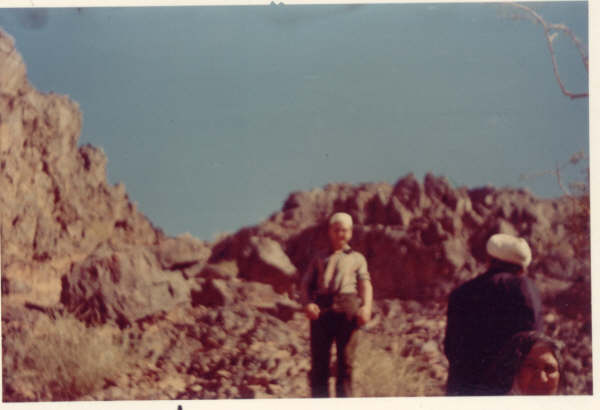
Me coming down after climbing a rock on Jebel Uhud near Medina above a cave where a wounded Prophet Mohammed rested during the Battle of Uhud in 625 CE (3 AH). Photo late January 1973.

As a youth in the 1960s in my hometown, Esch-sur-Alzette, I was always very insecure and confused about what I wanted to do with my life. As the eldest of six children, I was so confused that I could never be an example to my younger brothers and sisters.

My father, who was born in 1911 and who worked as a welder and mechanic in the iron mines and steel mills on both sides of the French-Luxembourg border, was very authoritarian in his younger years but mellowed very much with age. He had been hardened by experiences during and after the last war, when he had joined the German air force as an enthusiastic volunteer (he was crazy about airplanes and flying) after the Nazis invaded and occupied Luxembourg in 1940.

He worked for the Luftwaffe as a mechanic (he was past the age limit of 28 for fighter pilot training in the Luftwaffe, so his dream of flying Messerschmitt 109s and Focke-Wulf 190s could not be fulfilled) in occupied France and Germany, was captured by the Americans in Bavaria at the end of the war, and escaped from a POW camp. On his return to Luxembourg he was promptly thrown in jail and sentenced to eighteen years at hard labor for collaborating with the enemy. After spending more than 3 years in Luxembourg City’s Grund prison and several months cutting up disabled tanks on the battlefields of the Bulge in the north of the country he was freed in early 1949 when the government reduced the sentences of those collaborators who had not betrayed other citizens to the Germans. He never regained full civil and political rights in Luxembourg.

Well, I guess, hearing my father talk about his experiences I realized that I was a real wimp. I read adventure books about faraway places and felt the urge to travel. In 1972, at the age of 21, for the first time, I was allowed to make major decisions about my life and to manage my own money.

Up to that time I had always given everything I earned to my parents, and I got pocket money (I earned my first small salary as an apprentice at my hometown’s Arbed Belval ironworks in 1966-67, then switched to the “lycée” [junior high school] but left after passing a mid-level examination [“examen de passage”] a little over 2 years later and went to work in a bank from October 1969). All of my brothers and sisters, incidentally, became independent at a younger age.

From the beginning of 1970 I worked for Luxair airlines as a reservations clerk and had limited free travel. With my parents’ permission I flew to Vienna and Paris in 1970 and to London and Ivalo, Finland in 1971. On that last trip I hitch-hiked for a few days in September around the northern tip of Finland and Norway, covering about 670 kilometers and sleeping outside in a cheap sleeping bag, with a large sheet of plastic as my only protection against rain. One sleepless night out in the middle of nowhere near the northern end of Norway (at Ifjord near the Laksefjord, and east of the Prosangerfjord in the Finnmark) I was totally soaked and frozen in driving rain and strong wind — it was to be the first of many similar experiences.

So, in 1972 my real traveling began. In March of that year I flew to Tehran, Iran, which was the maximum distance I could fly for free based on the length of time I had worked for the airline. I knew practically nothing about Iran.

At the Asia Hotel downtown I met a young man from Kenya, of Indian Muslim ancestry, who invited me to go with him to Lahore, Pakistan, in his car, a huge Ford Galaxie 500 that he had bought in Missouri and shipped across the Atlantic to England, where his family lived, and then driven to Saudi Arabia on a pilgrimage to Mecca before coming to Iran. Taffy, as he was called, wanted to split expenses on the trip. I accepted, though I didn’t think I could make it all the way to Lahore because I had only two weeks’ leave from work. The two of us ran into an American ex-soldier, a giant of a guy named Bob Barrett, who was on his way overland to Australia, and he agreed to join us for the trip to Lahore. We drove north across the Alburz Mountains to the Caspian Sea and then east.

In the mountains west of the town of Bojnurd we got stuck in a heavy blizzard that raged for some 18 hours. We were almost out of gasoline and ill-equipped for the cold, so we huddled together and shivered through the night in the car. Late the next morning Iranian soldiers came on skis and brought bread, dates and cheese to us and the many other travelers who were stuck in the snow, which was at least a meter (3 feet) deep in most places.

An avalanche had blocked the road ahead for several hundred meters, but the soldiers managed to clear a path that people could walk to get to the other side of the blocked area. Some 30 hours after we got stuck in this place, with the road likely to be blocked for another day or two, we decided to try driving down that dangerous path — and by sheer miracle we made it to Bojnurd in one piece, though the Galaxie’s steering gear was damaged and had to be welded back together. This was to be only the first though perhaps the most dramatic of a series of adventures on this trip. We lost Bob in Herat, Afghanistan, and continued to Kandahar in the south without him. Taffy and I stayed 2 days in Kandahar, then he drove on towards Kabul and I had to take a bus back to Iran.

At Tayebad on the Iranian side of the border I was quarantined for 24 hours because I didn’t have cholera vaccination. In Mashad I slept with several other men on the floor of a small room in a poor area of town. I’d met one of the men in the street late at night when I arrived and he had invited me because there were no hotels around.

I had just barely enough money left to fly Iran Air back to Tehran’s Mehrabad Airport, where I could catch the once-weekly Lufthansa flight back to Germany the next day, and since I was worried that I might miss the flight if I went the long way back by road or rail, I decided to take the plane. I wound up spending a full day and night at Mehrabad, shaken by severe diarrhea and stomach cramps, and unable to sleep, with no money left to go anywhere else or buy food or medicine. I was still lucky to get a seat on the plane out the next day (with a free ticket you cannot reserve seats and depend on there being some left vacant).

When I got back to Europe I felt that the little adventure had somehow changed me in a fundamental way. I found it extremely hard to re-adjust to the workaday routines in Luxembourg, even though I had been away only 2 weeks.

In September 1972, a month after smashing my first car in an accident on the French side of the border, I left my job at Luxair and flew to Cayenne, the capital of French Guiana, with my last free ticket from the company. I thought I might stay in Cayenne but found on my arrival that it would be very hard to get a job or a place to stay other than in one of the rather expensive hotels in town.

In my pocket I had a letter from Taffy inviting me to Munich, where he thought the two of us could do some business together and make a lot of money in the wake of the Olympic Games. I felt I needed more money anyway in order to get started in South America, so, after only three days in Cayenne I flew back to Paris and hitch-hiked to Munich.

I did work in Munich but also spent a lot of money at the Oktoberfest while I was waiting for Taffy to show up, and less than 2 months later I was broke. I hitch-hiked back to Luxembourg in November, spending at least one night out in the cold next to a German Autobahn highway where nobody was willing to give me a ride until the following day.

Within a week or two after I got back to Luxembourg I got a letter from Taffy inviting me on a trip by car to Lahore, Pakistan (again), to visit some of his sisters and other relatives there. He wrote that he and his brother Fakhar and Fakhar’s wife and their three small boys were coming from England in two cars, and they needed me as a backup driver because they were pressed for time and would have to drive through the nights.

It turned out that they had to pick up their old and arthritis-plagued mother at the airport in Jeddah, Saudi Arabia, on a certain day in early January 1973 and to take her to Mecca and Medina for her first, and probably last, Haj — the full Islamic pilgrimage.

According to their tentative plan, we would drive as quickly as we could to Kuwait, where I would stay with their eldest brother Hamid, then they would race across Saudi Arabia, pick up their mother and perform the Haj with her, see her off at Jeddah on the flight back to London about a month later and come back to pick me up in Kuwait for the final leg of the trip to Lahore. I was gung-ho, of course.

The two cars were a Volkswagen van with a big mattress and a gas cooker in the back, and a powerful Ford Capri 3000 GT sports car. We left Luxembourg on 19 December 1972. Germany, Austria, Yugoslavia, Bulgaria, Turkey. We stopped at the famous “hippie trail” Pudding Shop ( https://en.wikipedia.org/wiki/Pudding_Shop ) near Sultan Ahmed mosque in Istanbul and crossed the Bosporus by ferryboat (there was no bridge as yet).

Somewhere in the mountains south of Ankara, at night, with Fakhar and his family sleeping in the back of the VW and Taffy far ahead downhill in the Capri, I lost control of the van in a nasty curve and skidded off the road to the edge of a deep, black precipice. I managed to stop at the very last moment, and I think one of the front wheels no longer touched firm ground. It was really a close call. I found Taffy waiting just around the bend. He must have realized how dangerous the curve was, but he hadn’t seen the near-miss. Fakhar and his family didn’t wake up, and I didn’t tell them about it.

After that we kept going through the night, to Aleppo in Syria, where we arrived in the wee hours of 24 December 1972, and then east towards the Iraqi border. It was a harrowing drive in the night to Raqqa, some 200 kilometers east on the Euphrates River, with dozens of trucks coming towards me on the narrow road, one after another, blinding me with their high-beam headlights that they apparently could not dim. At dawn just past Raqqa the sun came up right in front and blinded me completely. I had to give up and let Fakhar take over.

When I woke up a few hours later, the windshield was gone: a stone that fell from a truck had smashed it. We had to improvise, making a new windshield with sheets of plastic that quickly became covered with scratches. At Abu Kamal (or Al-Bukamal) on the border with Iraq our journey ended for the time being. The Iraqis refused to let us enter their country, insisting we had to get visas (this was apparently because of a diplomatic dispute with Britain at the time — my friends were British subjects).

Fakhar and his family stayed behind with the VW while Taffy and I raced the nearly 500 kilometers of mostly miserable road back to Aleppo in the Capri. At Aleppo we found out that we had to go to the Iraqi Embassy in Damascus, another 400-odd kilometers away to the south. In Damascus we learned that it would take about 2 weeks to get the visas. Impossible. No way we could get to Kuwait and then Jeddah in time.

There was only one way to go: directly south through Jordan to Medina and then Mecca and Jeddah. But that meant I could not go with them, since I was not a Muslim and would not get permission to travel with them to the holy places in Saudi Arabia. Taffy said I could go back to Europe on my own, or, if I agreed, I could officially become a Muslim and go with them. I chose to become a Muslim.

We raced back to Aleppo and from there all the way back to Abu Kamal, because we couldn’t reach Fakhar by telephone and the Capri with its low ground clearance would never have made the shortcut across the desert via Palmyra. And again we drove the two cars to Aleppo and then to Damascus (the Capri had thus covered close to 3,000 km in Syria alone). Taffy and Fakhar became my witnesses at the Saudi Embassy, and I was given an official pilgrim’s visa for Saudi Arabia under the name Omar Hussein. This is how I became a Muslim.

We drove to Jordan. At the border, before leaving Syria, we had to pay a special tax that we were told was levied on all pilgrims who had received their Haj visas in Damascus. In Amman, the Jordanian capital, we met a friend of Taffy’s whose name I don’t remember.

We drove on to Ma’an and then Aqaba but found out that we wouldn’t be able (or allowed) to cross into Saudi Arabia from that Red Sea port. We had to backtrack the 100-odd kilometers to Ma’an and then head for the border at Al Mudawara.

My personal impression was that the people I met in Jordan were more suspicious of me than the Syrians had been, sometimes hinting that I might be an Israeli spy. This is exactly what Saudi officials opposite Al Mudawara did, too. We spent the night of 29-30 December 1972 at the Saudi border post.

The officials found a radio-electronics kit that I had bought in Luxembourg for a friend of Taffy’s in Kuwait. When they realized that it was possible to build a tiny radio transmitter with it they refused to let me take it into Saudi Arabia, saying I might use it to transmit information to the Israelis. They didn’t even let me send it by mail, so we had to leave it at the post, where Taffy’s friend in Amman could later pick it up. (….. to be continued …..)

A little more about my trip to Mecca … -Excerpt from a message to a friend Jan. 2004 [there is more information about my pilgrimage in this interview about my journeys to Afghanistan, Saudi Arabia and Pakistan: Afghanistan, Saudi Arabia, Pakistan – my story 1970s-80s

… Talking about the Middle East, I wonder if I ever sent you my little story of how I went on the Haj. I haven’t written the whole experience down yet but I have the beginning of the tale in some autobio notes I wrote a few years ago and may continue someday.

I got only as far as late December 1972, on the border between Jordan and Saudi Arabia. You can read it in the attached text file. I spent over a month in Saudi Arabia after that. My friends wanted me to marry a 16-year-old Pakistani girl by the name of Razia in Jeddah and then try to get a scholarship to study at the Islamic University in Medina, etc… But I was not ready for that and wanted to continue traveling with them.

We then spent 9 days with their eldest brother Hamid and his friends in Kuwait (in the villa of the Al Balool family – former postmaster general of Kuwait), then Taffy dropped me off in Abadan, Iran, to fend for myself, saying I could not come with them to Lahore because I was not serious enough about being a Muslim and their family there would not like that.

So I “celebrated” my 22nd birthday alone (and nearly broke) in Abadan, then tried unsuccessfully to get a job working on a ship in nearby Khorramshahr, and finally somehow made my way back to Europe by train and hitch-hiking via Tehran and Istanbul, etc. at the end of February 1973. This was a little over 2 years before I met the UC in New York.

In the summer of 1973 I went to England and worked at Heathrow Airport, then later as a bus conductor in Rochdale, Lancashire, where I rented a room in a house that belonged to Taffy and his family — and spent a lot of time with them. They were not mad at me for not being a good Muslim — they actually didn’t take it all that seriously themselves. I still keep in touch with them, and Taffy still lives in Rochdale but travels a lot on business. He has visited me in Luxembourg twice in recent years. –— MORE BELOW THE PICTURE:

Mecca Saudi Arabia sometime in January 1973

Mecca Saudi Arabia sometime in January 1973

MORE: …. Here is an excerpt from a chronology I wrote elsewhere, with a bit more info on my Haj and the time in England, and the beginning of my first journey to the United States [that chronology is here in full: Timeline of my first 40-odd years  ].

“… 1972 Dec 30 to 1973 Feb 1: Saudi Arabia; Haj, Medina, Mecca, Mina tent city, Jeddah; then across via Riyadh to Dammam and then Kuwait City. — We drove to Medina, where we met Taff’s Filipino friend Abdullah Mahdi (original name Leonardo Villar), who studied at the Islamic University there. Abdullah was to be our guide. The only two photos I have from my time in Saudi Arabia were taken by him. In Medina we had to prepare for our first visit to the Kaaba in Mecca, over 400 km to the south, by taking a bath and putting on our Ihram clothing, the two simple white sheets wrapped around the body that must be worn during the pilgrimage.

We arrived at the holy mosque in Mecca late in the evening of 31 December 1972, and I slept part of that night on some steps in the colonnade surrounding the big central courtyard where crowds of people were making the rounds of the Kaaba in a counter-clockwise direction – what is called the tawaf.

The next day we performed the same rite and the prescribed walks between the small rocks of Safa and Marwa, and drank the water of the Zamzam well, etc. Later we set up a big tent a few kilometers outside the city in Mina among thousands of other tents. We lived there for the next two weeks or so, and returned to Mecca a few times for further rites in the great mosque. A few days after arriving in Mina we went to Jeddah to pick up Taff and Fakhar’s mother, Ummi, from the airport. She stayed with us in the tent in Mina, and for the tawaf in Mecca we paid two men to carry her around the Kaaba on a sort of stretcher with a basket in the middle.

Near the end of our stay in Mina we spent a day at the foot of a hillock called Jebel Arafat, a few kilometers away, and then picked up pebbles in a place on the way back to Mina called Mustalifa. The pebbles were used the following day to throw at the shaytan (devils -petrified in this case) in Mina, three stone pillars with low walls around them. Also, an animal had to be sacrificed for every pilgrim. I gave some money to my friends who arranged for sheep to be slaughtered for us. I saw huge herds of sheep, goats and other animals near Mina, and large piles of bones of animals killed in earlier years. As a white European I seemed to be a curiosity in Mina and was invited by many people into their tents for a cup of tea and a chat.

After the main part of the pilgrimage in Mecca and Mina was over we returned to Medina and rented a ground floor apartment in the old quarter behind the great mosque. We stayed there for more than a week together with Ummi, mainly to say the 40 prayers during 8 consecutive days prescribed in a hadith (=an account of the sayings and actions of Prophet Mohammed), and to visit the prophet’s tomb and the Jennet Al Baqi cemetery, where many of his relatives and companions are interred. We also visited Jebel (Mount) Uhud and various other important sites from the early history of Islam. I could not resist climbing to the top of a rock on the 1,077-meter Mount Uhud above a famous cave that played a role in the Battle of Uhud – the second battle in Islamic history, and Abdullah took a picture of me coming back down, which I still have. The quarter where we stayed seemed like a town from the Middle Ages. I learned from Abdullah much later that it was torn down a few months after our stay to make room for an expansion of the mosque.

After we saw Ummi off at Jeddah airport on a flight back to London we stayed a few days in the house of a Pakistani family living in Jeddah. My friends suggested that I could perhaps marry one of the daughters of this family, a 16-year-old girl named Razia. They said I might be able to stay in Saudi Arabia and get a scholarship to study at the Islamic University in Medina – just like Abdullah. I told them I was not at all ready to get married and settle down. They were concerned that I was not serious enough about studying and practicing Islam, and they felt their relatives in Pakistan, with whom we were going to stay, would not appreciate that. Taff and Fakhar themselves did not worry so much about me not trying hard to be a good Muslim but they believed their family would not accept me as I was, and this is why they no longer wanted to take me to Pakistan with them. Their family in Lahore would have been informed by Ummi that I had been on the pilgrimage with them.

So I decided to try to find a job on a ship. We first went to the port of Jeddah but were not allowed to enter for this purpose.

1973 Feb 1 to Feb 27: drove from Jeddah to Riyadh via Taif and then on to Kuwait City (arriving 1 February), where we spent 9 days in a villa of the Al Balool family with whom Hamid lived, then via Basra/Iraq (ferryboat across the Shatt Al Arab waterway) to Abadan/Iran, where I stayed behind alone to try to find a job on a ship, there and in nearby Khorramshahr. No chance. I took a train to Teheran (on my 22nd birthday, 11 February), stayed a few days, then took another train to Istanbul/Turkey, stayed 2-3 days, then went again by train via Belgrade to Ljubljana/Yugoslavia (now Slovenia) and on by bus to Kranj, which cost me my very last penny. From Kranj I hitch-hiked back to Luxembourg over 2-3 days, spending nights outside in the cold (February).

1973 Mar to July: worked short-term jobs in Luxembourg, then about 2 months at Avis car rental agency, Luxembourg Airport.

1973 July 8-15: Flew Luxair Caravelle to Monastir, Tunisia, together with my father (his one and only trip outside Europe), using free tickets provided by my brother, who still worked for the airline (he was going to make the trip with my father but then something came up that prevented him, so I used the ticket issued in his name). We had a good one-week vacation in Sousse and Tunis together, and also visited the ruins of Carthage.

1973 July 20 to 1974 Feb 14: England and Ireland; went by train and ferryboat to England, lived in Hayes/Middlesex until end-August (6 weeks) and worked for Trust House Forte at Heathrow Airport Terminal 2 duty-free store; then moved to Rochdale/Lancashire at the invitation of my friend Taffy, lived in a house owned by his family and worked as a bus conductor for SELNEC Northern bus company based in Manchester; left the job and the town abruptly early November when confronted by Muslim co-workers who knew I was a Haji (one of them had come to my favorite pub one evening to buy cigarettes and saw me drinking beer there – which is haram – forbidden for Muslims); moved to Kensington/London and worked at Army and Navy Stores on Victoria Street in the Radio and TV Department; left the job in December and traveled by train and boat to Dundrum near Dublin/Ireland where my brother stayed with friends; spent ca. 3 weeks in the Dublin area, mostly drunk and high on hashish and opium (took LSD just once); together with my brother, his girlfriend and others returned to London via Liverpool, then stayed again in Kensington and worked short-term jobs for Industrial Overload at Tottenham Court, including a 2-day stint carrying large furniture eight floors up in the main BBC building.

1974 Feb 14 to early March: Left England for the continent, almost penniless again; hitch-hiked to Verden south of Bremen in Germany, spent one night out in the snow, then met some hippies whose address I got in London from 2 French professional thieves; the hippies gave me an address in Paris, so I hitch-hiked to southwest Paris, where other hippies at the given address let me stay in their well-stocked apartment near rue de Versailles while they were away on a vacation in the Savoie; stayed 10 days in Paris (the hippies had given me permission to eat the food in their refrigerator, and even let me have a plentiful supply of strong French Gauloises cigarettes — I smoked heavily in those days, whenever I had money) and walked all over the city; the hippies from the apartment were members of Mouvement pour la libération de l’avortement et de la contraception (MLAC), and based on some evidence I found might have performed abortions in their apartment; finally I hitch-hiked from Paris to Longwy and walked from there during one night in a few cm of snow to Belvaux (about 20 km), where a driver gave me a ride home to Esch in the early morning.

1974 Mar to 1975 Mar: worked short-term jobs (for Manpower Lux. City), then was accepted by Dupont De Nemours to work in the Typar physical testing laboratory near Contern (a small town a few miles outside Luxembourg City), rented a room in Contern; worked at Dupont nearly 6 months then got bored by routine and quit; worked odd jobs again for Manpower, including one for 2 weeks at Eurotex (not sure of name? – we were doing quality control of freshly-assembled JB Lansing loudspeakers) near Bascharage where my boss was an American evangelical Christian (forgot his name) who told me a lot about the Last Days, the Apocalypse, as interpreted in the book The Late Great Planet Earth by Hal Lindsey.

During this time I developed my ideas about a coming nuclear World War III that would wipe out modern civilization, probably around 1979; I made my plan to go live in the woods of British Columbia/Canada for at least one year as a survival test and then head for the southern hemisphere – Patagonia to wait out the expected nuclear war; my final job in Luxembourg was a 3-month stint as a van driver delivering washing machines and other large household appliances all over Luxembourg for Neckermann in Lux. City.

1975 Mar 6: USA, first journey: 4 years and 4 months until 1979 July 7: Flew to New York, intending to take a train to Montreal and hitch-hike to British Columbia; met Noriko Sawaura of Japan (and others) in front of Madison Square Garden, who invited me to a lecture on “Divine Principle”, talking about the Last Days (right up my alley that time) and the need to unite religion and science, etc.; lecture by Irishman Aidan Barry was interesting; agreed to attend a 3-day workshop in the countryside upstate to learn more about this movement, Unification Church and its founder Sun Myung Moon of Korea; went to Barrytown 170 km north of NYC on the Hudson River with many other young people, and after much prodding from some of them stayed after the 3 days for 7-day, 21-day and 40-day workshops; decided the Moonies with their Divine Principle had a better idea that could save humankind without first destroying civilization as I believed necessary, and I joined them (later that spring in Barrytown I saw Moon for the first time; he did not make a good first impression: he looked like a rich westernized businessman and seemed extremely arrogant — but I was sufficiently impressed with many of my new Moonie friends and the Divine Principle to overlook this; I was never able to shake off that first negative feeling, though); worked on the small farm (we grew corn, etc.) at Barrytown, then spent over a month in Boston restoring a basement apartment where we then invited people to try to bring them into the fold.

Later I worked in New York City and traveled a few times in a big truck to the Sophie Mae factory in Atlanta/Georgia to pick up loads of peanut brittle (candy), which we dropped off for mobile fundraising teams (=teams of young people who went door to door or approached people in shopping mall parking lots to sell candy, flowers, etc. at inflated prices allegedly for a good cause but in reality for the Moon movement – usually without disclosing for whom they worked) in the Carolinas, the Virginias, Tennessee, Kentucky and Ohio; finally I moved to Washington DC to work in a church printshop but felt constrained and bored, and decided to travel around on my own and to think about God and the world without having Moonies all over me; I told my friends I had to leave them because I needed a break but would be back within anywhere from three days to two years; I wanted to visit a friend with whom I had worked in New York and who had left the Moonies to return home to California; the others asked me to promise to visit a church center in California, which I did.

1975 Nov 11-27: 16 days’ “vacation” from the Moonies: hitch-hiked from Washington DC to Durham/North Carolina (where I spent a night under a highway bridge), then along Interstate Highway 40 up to Asheville near the western end of North Carolina; was getting ready to sleep under another bridge there when a blue car stopped by the side below; amazingly the driver (whose name I don’t remember, only his handle on CB radio: the Blue Blazer) was on his way from Miami/Florida to a place called North Highlands in California; he took me along; we drove along I-40 across Tenneseee, Arkansas, Oklahoma, Texas (Panhandle – Amarillo) and New Mexico to Arizona, where he dropped me off in Seligman west of Flagstaff (he wanted to go back to Ash Fork to visit relatives there who could tell him where North Highlands was, since none of the many truckers he contacted via CB radio had known the place — much later I learned that it was a suburb of Sacramento).

I hitch-hiked to Kingman/Arizona and then in the night on to Yucca (the big burly guy in a pickup truck with a rifle inside who picked me up late evening in Kingman threatened to throw me out in the desert if I didn’t give him a blowjob — but I managed to get him interested in talking about God and the world’s problems, and when he dropped me off near Yucca he said it was the most interesting conversation he’d had in years); slept under a bridge on I-40 near Yucca and got a ride next morning with a Mexican family on the bed of a pickup truck among sacks of potatoes and onions; they took me to Thousand Oaks west of Los Angeles, then I continued to Santa Barbara, and on Highway 101 to Arroyo Grande, San Luis Obispo and on to San Francisco, and across the Golden Gate Bridge to San Rafael, where I stayed a few days with my friend Brad.

Brad later took me to Sacramento. I wanted to travel north to British Columbia, going back to my original plan before I met the Moonies. I tried to hitch-hike north for 3 days (sleeping in some bushes near Interstate Highway 5 to Redding) — no success. Then I met a hobo at the local soup kitchen and he talked me into going south with him to Indio, near Los Angeles, where he was sure we could get jobs during the winter (I could always go to BC later on). We rode freight trains but got only as far as Stockton. Later, not far from there, he got badly hurt on one train, breaking his hip bone, and I had to take him to a hospital in Tracy. I couldn’t stay with him: I was an illegal alien (that’s another part of the story).

Later the same day, Thanksgiving Day (Nov. 27), I was robbed of all my possessions except my passport and a few dollars near Livermore, then a fundamentalist Christian guy gave me $ 60, and I was about ready to look up the church again. I couldn’t find the church center in Berkeley, but in the evening I ran into two young guys who invited me to a free Thanksgiving Dinner at a place on Hearst Avenue near Berkeley campus. That turned out to be the Unification Church, under a different name (Creative Community Project)….

[more on that adventure here: Memory of California Thanksgiving 1975  ] 

Categories: Travel | Leave a comment

Blog at WordPress.com.